Breeding For The Table |
||
NEW ZEALAND BREEDING & REARING Raising rabbits for meat is a really enjoyable and worthwhile passtime, You raising good quality, low cholestoral meat, Providing great fertilizer for any vegetables that you grow, If you have young children you are also showing them where exactly meat comes from and to respect animals. All the rabbits in my care are ensured to have a good quality life, They all get named and as the case with animals you lose one now and again - be it birthing problems or old age - there is sadess with the loss. I started off importing two bucks and four unrelated doe's from the UK in 2009 with a friend - who took one buck and two doe's and I also took one buck and two does. Later on we went to Wales where we took in another two does and one buck so we had plently of different lines and blood to work with. We had not got a lot of experience with breeding rabbits and learnt most of what we know from the internet and talking to other new zealand breeders in the USA where rabbit meat raising is quite popular, I found some rabbit breeders here in Ireland reluctant to share any information and also annoyed that I was breeding rabbits for meat but If they eat beef or chicken it is hypocritical to react like this. First of all Im not claiming to be an expert, I have only bred this rabbit for two years and a lot of it you learn as you go along but if you know the basics its not that complicated. Firstly you can start off with one doe and one buck, Does will need a larger cage space than the buck as she will almost always have between 7 & 8 babies to raise and they will need the space - My brood does hutches are 5ft long by 2ft wide by 1.5ft high. You can make your own hutch much cheaper than going out to buy one - you can also have it exactly how you want it, The best way is to have a rigid wire base that the urine and pills fall through - there is less faeces then in the hutch and the kits have less of a chance of picking something up - otherwise if you have a wooden base then regular cleaning (I do it daily) of the base of the cage is important and also once a week use bleach and water in a spray bottle and spray the base to kill any bacteria that may build up, Young kits immune system is not very strong and its important to keep their environment clean. A maiden doe can be mated at six months - the bucks usually start at seven although I have had a buck fertile at only 5 months so it depends on the rabbit, A rabbit will mature much quicker if he or she is housed on their own in their own hutch. You will take the doe to the buck - as does are territorial and may attack the buck so that is rule number one, When the buck mates the doe sucessfully he will fall over onto the floor, I only leave my does in with the bucks for 5 minutes maximum and dont put them back for a second mating - some people do in the hope that they get a bigger litter but a huge litter of 11 or 12 is not fair on the doe and you will also end up with a weak or skinny litter - 7 good sized healthy, stocky kits are better than 12 skinny, small kits - they are also more prone to picking something up as they will not be as strong as a smaller litter, So if I have a doe that has a litter like this I will take the out the smaller ones at birth and leave the litter at a manageable 7 or 8. A does pregnancy lasts 30 - 31 days - and are usually always on the button, She will make a nest (Always make sure the nest is not in the area that she uses as her toilet) - she may pull fur but this usually happens just before she will kindle. If you notice that she is pulling her fur and you think that it would be fun to watch - DONT - You can put her off and this can put her in danger and also the kits, Once she has them you can look the next day. She may be a little over protective of the litter so just watch your fingers when you look into the nest, For first time mothers its best if you remove the doe from the hutch and check the litter for runts or to remove any dead kits, Dont spend too much time at it as your smell will be all over the kits and the nest, You can place her back in after. I check the new mum and kits in the morning and in the evening to make sure none have fallen out of the nest - as they are born blind and deaf and can quickly die with the warmth of the others, If one has fallen out I simply place it back into the nest. With New Zealands it is rare for the mothers to ignore their babies - some rabbits will kill the litter or just not feed them but I have yet to see a new zeland do this. They are excellent mothers. The kits will start nibbling at hay and pellets at 2 - 3 weeks, and they soon figure out how to use the water bottle, Once I see a kit has left the nest - I remove the nest, Take all the fur and also all the other bedding in the hutch and disenfect it with the wattered down bleach - the kits have been using this as their toilet for two weeks before they could leave the nest and its not very hygenic for them to nest here for longer - so everything goes. They will return to the same corner to sleep and rest. Always feed from a clean bowl in the area that they dont use as the toilet, We wouldnt eat our dinner in the bathroom. A lot of breeders wean their kits at 6 weeks - either by removing them from the hutch and placing them into another hutch - they will also have bred their doe up again at four weeks, This honestly does not work - It hasnt worked for me anyway - I breed my doe (If shes fit for another litter) at 7 weeks - leave the kits in with her until the doe is 3 weeks pregnant and then remove the doe from the cage when the kits are 10 weeks and place her into a new, disinfected, clean cage to have her new litter. This reduces the stress involved for the kits - as they are still in the cage where they were born and reared and have passed the critical weaning age of 8 weeks. Weaning time 7 - 8 weeks is the time when you will most be likely to lose kits - stress of moving often triggers bloat - Bloat is when their digestive system stops and the food in their stomach starts to ferment and creates gas that cant escape - this can also be caused by over feeding and being kept in unclean, unsanitary conditions - So always make sure to disenfect your hutches. Also feeding of greens and veg is not good as they take longer to digest in the rabbits gutt and stay there longer - that is why breeders tell you not to feed greens and veg until the rabbit is over 3 months old. A diet for kits from 0 - 3 months should only consist of hay, pellets and clean water - by adding more you are only adding more problems. After the kits are 10 weeks old - you can remove the bucks from the does and place them in a separate hutch - making sure that you are feeding the correct amount - Fibre at this stage is more important than large amounts of pellets so feed plenty of hay to keep the digestive system moving and you can gradually increase the pellets as the weight of your kit increases, Some breeders "free feed" as in they have a constant supply of pellets but I find that constant hay is better. I feed RUSSONS PELLETS which is 16% protein mixed with bagged CHAFF. Chaff is a low protein hay - like chopped up fine hay, You can buy it in some equine supplies stores. It comes bagged and there is a lot less waste compared to hay as you can add it directly into your bowl with the pellets. Theres several types of Chaff - some have a coating with molasses so be sure to get the natural one - as molasses may cause stomach upset as it will be high in sugar. I sell 25kg of RUSSONS PELLETS for €17, But as Im based in Monaghan you must order 3 bags minimum otherwise its not really worth your while travelling for them but any bags I have bought elsewhere are almost € 20 for only 15kg !!! If you have a herd of hungry rabbits and you are going through one bag a week it all adds up over the year. You can contact me if you want to buy pellets. I think I have mentioned everything here that Iv learnt in the past two years but if you have nay questions please contact me and I'll try answer any quetions you have. |
Three high home made hutches - Does quarters  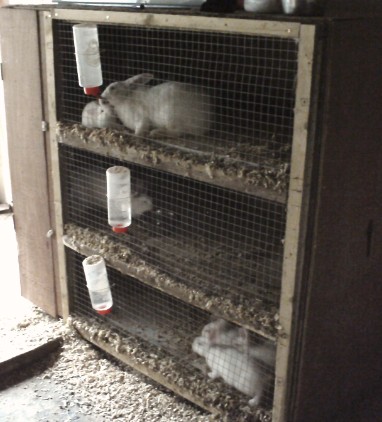         |
|
